

Türkiye’s first indigenous unmanned fighter aircraft Bayraktar Kızılelma, developed by Baykar Technologies, is progressing towards serial production, with plans to commence in 2024.
Baykar, a prominent Turkish defense company, achieved a significant milestone when the Kızılelma rolled off the production line in November 2022. Following this, a series of ground tests were successfully completed at the flight training and test center in the northwestern province of Tekirdağ’s Çorlu district.
The forthcoming objective is to initiate mass production of the warplane in 2024. Furthermore, the drone is scheduled to commence flight tests from Türkiye’s largest warship TCG Anadolu in 2025, further solidifying its potential as a formidable addition to Türkiye’s military fleet.
As of now, two prototypes of the drone have been produced, showcasing remarkable progress in the project. Last December, Kızılelma embarked on its maiden flight, taking to the skies within a year of its production. Throughout April, the aircraft underwent rigorous flight and system identification tests, all of which were completed with success.
Kızılelma is able to carry 1,500 kilograms of payload (weapons and devices, etc.). Its flight range is 930 kilometers, while the operating altitude was declared as 10,668 meters. The drone can operate in the air for five hours and has a maximum speed of 900 km/h.
In other recent developments, Baykar has made notable export agreements. To kick off 2023, the company signed a lucrative agreement with Kuwait’s Defense Ministry, resulting in an export contract worth $370 million for the Bayraktar TB2 unmanned aerial vehicle. The latest export agreement was inked with Romania, adding Bayraktar TB2 to the inventories of four NATO member countries.
Source: Hürriyet Daily News
The SOM-A cruise missile is listed among the ammunition of Baykar’s Akinci Fighting UAV.
Kuzgun Project is fascinating which aims to transmit images captured by Bayraktar TB2 to armed forces in the field instantly through a tablet.
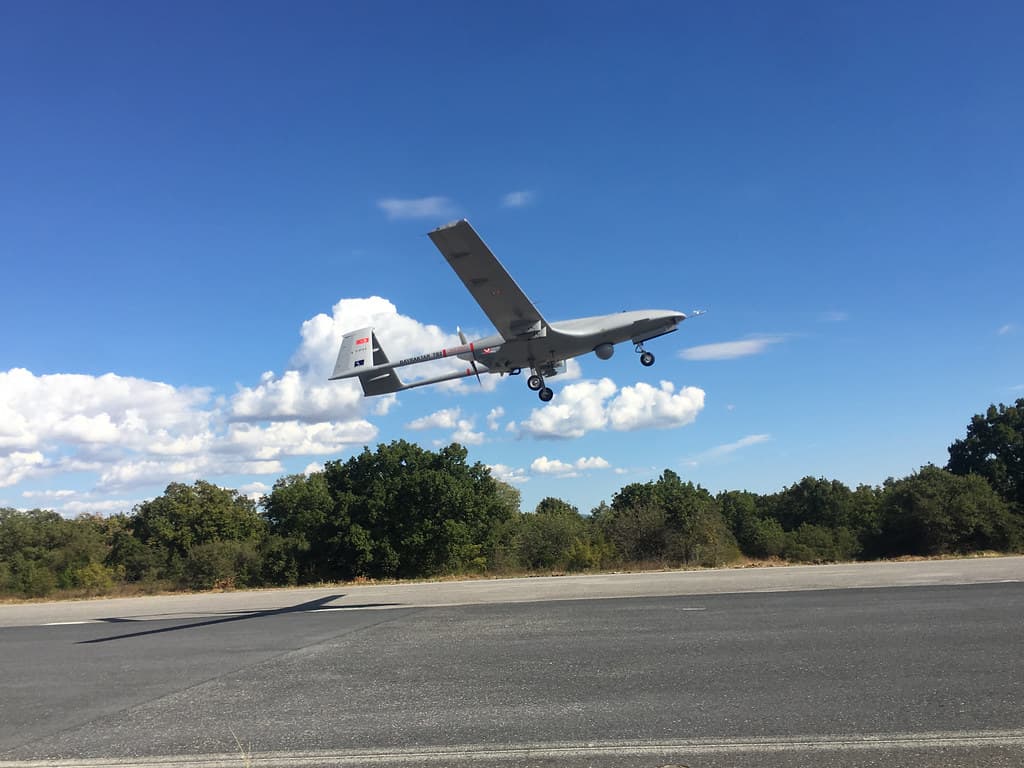
"Those shiny tanks are being set ablaze -- Bayraktar -- that's the new craze," go the lyrics of a popular Ukrainian song dedicated to a drone that has become one of many symbols of the nation's resistance.
Maintenance, Repair & Overhaul (MRO) Center
Service Provider for Unmanned Aerial Vehicles
All Rights Reserved. © 2026
